
July 24, 2026 · TheSpotMind
Posting Every Day Won't Grow Your Account: How Often to Post on Social Media in 2026
Posting daily won't grow your account. Here's how often to post on social media according to 2026 benchmarks — and what the algorithm actually rewards.
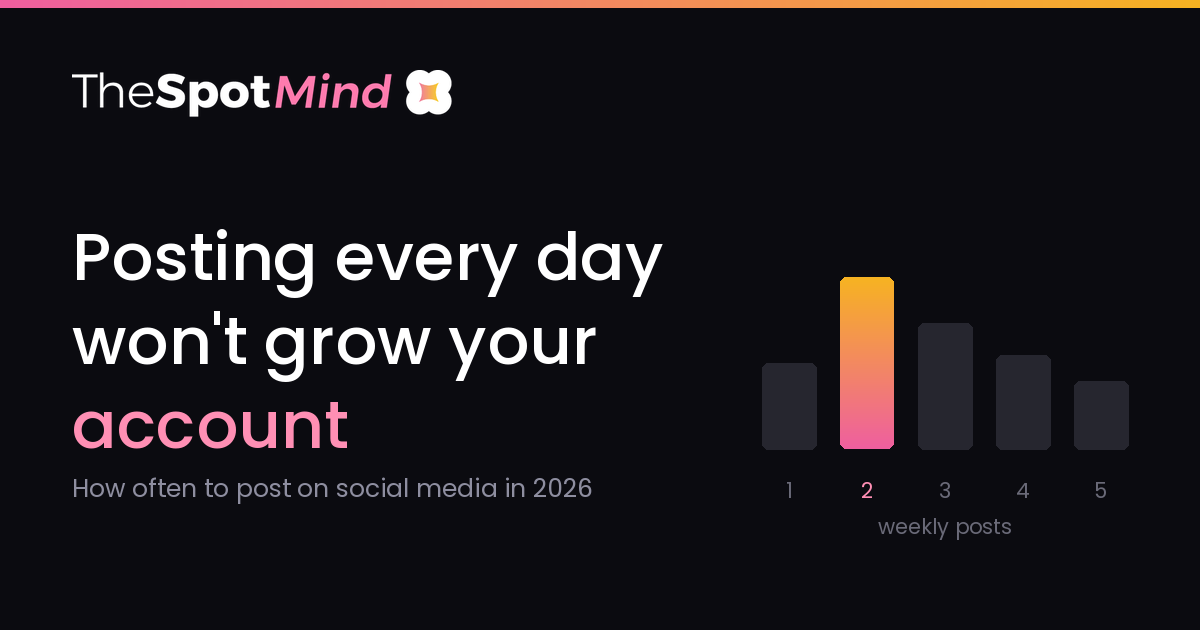
Short answer: in 2026, engagement peaks at two posts per week on Instagram, LinkedIn, X, and Facebook. Posting more doesn't increase reach proportionally — but going silent does hurt an account's performance.
Are you posting every single day and your community still looks the same? It isn't a matter of effort. The 2026 data shows that volume stopped being the variable that matters — and here's what replaced it.
The myth everyone repeats: "post more and you'll grow"
The most widespread belief in social media is that a higher posting volume produces more growth. The 2026 data doesn't back it up.
If you're a personal brand, a business owner, or a community manager, you've probably been told that the more posts, stories, and interactions you put out, the more followers, likes, views, and comments you'll get. It all comes down to one very repeated premise: extreme consistency equals better results.
It sounds logical. The problem is that the numbers say otherwise.
How often should you post on social media? Twice a week, according to 2026 data
Engagement peaks at two posts per week across all four major platforms, according to Hootsuite's 2026 benchmarks:
| Platform | Weekly frequency with the highest engagement | Engagement |
|---|---|---|
| 2 posts | 4.04% | |
| 2 posts | 3.56% | |
| X (Twitter) | 2 posts | 2.21% |
| 2 posts | 2.08% |
Source: Hootsuite, Social Media Benchmarks 2026
Yes, you read that right: two. Hootsuite analyzed performance across thousands of accounts by industry and landed on a conclusion that's uncomfortable for anyone who posts nonstop: in many cases, a few well-planned posts per week drive more engagement than posting daily.
And if your brand lives in marketing, the pattern holds. In the agency category, Instagram engagement also peaks (4.00%) at two posts per week.
The bigger picture doesn't favor posting for the sake of posting either. Socialinsider reviewed 70 million posts and found Facebook averaging just 0.15% engagement, while TikTok dropped 10% year over year. Comments per post fell too: 24% on TikTok and 16% on Instagram. Translation: there's more content than ever, and audiences are interacting less.
Why doesn't posting more increase your reach? Here's how the algorithm works
Posting more doesn't increase reach because social media algorithms prioritize the relevance of each individual post over the total volume you produce.
Every platform — Instagram, Facebook, X, LinkedIn, or TikTok — runs on an algorithm: a set of computational rules and procedures that decide which content gets classified, prioritized, and shown to each user. Those rules no longer reward how much you publish. They reward how well what you publish connects. If your content doesn't spark a reaction, the algorithm simply stops showing it, no matter how many times you try.
Look at it from the user's side and it clicks immediately. You've definitely lived this: a brand hits you with promo images, videos, emails, and DMs pushing their product or service. Once it gets that repetitive, you get bored and end up ignoring them — or worse, muting them. That's exactly the signal the algorithm picks up on.
Does posting less hurt your reach? Only if you stop completely
Lowering your frequency doesn't hurt an account, but disappearing does. Accounts that go a full week without posting underperform their own baseline, according to Buffer's analysis of more than 52 million posts and 4.8 million weekly channel observations. In fact, top-performing accounts publish more often and more consistently than the average account.
So where does that leave us?
It leaves us here: volume was never the enemy — posting without intention is. Disappearing hurts you, but flooding the feed with generic content won't save you either.
There's also a technical detail almost nobody mentions: engagement rate is calculated per post. Post more and that percentage drops almost by pure math, without your account necessarily performing worse. That's why the number only tells half the story, and why you should always read it alongside reach and your community's actual growth.
What does the algorithm prioritize? Relevance, experience, and quality
Social media algorithms prioritize three factors over frequency: how relevant the content is to a specific audience, how good the experience of consuming it is, and how carefully it's executed.
Relevance: speaking to someone specific
Relevance is how useful your content is to one concrete person. Before you create anything, answer this: is this useful to someone specific? Content that speaks to everyone speaks to no one. The clearer you are about who you're talking to, the easier it becomes for the algorithm to find that person for you.
Experience: how easy your content is to consume
Experience is how it feels to consume your post, not just what it says. A carousel that's easy to read, a video with decent audio, copy that doesn't make you work for it. It's what makes someone stay on your post instead of scrolling past.
Quality: clear message, right format
Quality doesn't mean cinema-level production. It means the message is clear, it gives something back, and it looks like you cared. Format matters too: according to Hootsuite, carousels lead on Instagram (4.2%), albums on Facebook (2.9%), and videos on LinkedIn (3.9%).
How do you post with intention? 5 steps you can apply today
Posting with intention means every post has a defined goal, a clear audience, and a format chosen on purpose. Here's how to do it:
- Lower the frequency, raise the bar. Before you add one more post, ask yourself whether the last one actually worked.
- Give every post a job. Educate, entertain, start a conversation, or sell. If you can't name it, it isn't ready.
- Use the format each platform rewards. The same content doesn't perform the same everywhere, and recycling without adapting always shows.
- Reply to your comments. Buffer found that creators who respond to their community outperform those who don't, across every platform they studied. It's the cheapest thing you can do for your engagement.
- Set a pace you can actually keep. Two posts a week you can sustain all year beat seven a week for three weeks followed by silence.
Which social media metrics should you track?
The key metrics are reach, engagement per post, saves and shares, follower growth, and the hours when your audience is most active.
Every platform you use hands you that data along with free tools to understand your target audience: which formats work, when your audience is online, and which posts get the most reaction.
That's the information that gets you out of guessing mode. Use it — that's exactly what it's there for: to help you grow.
Frequently asked questions
How many times a week should I post on Instagram? Twice a week is the frequency with the highest engagement overall in 2026 (4.04%). The ideal number shifts by industry and account size, so treat it as a starting point and validate it against your own metrics.
What's a good engagement rate on social media? Between 2% and 4% is considered good as a general benchmark. It varies quite a bit by sector: education accounts average 5.4% on Instagram, while marketing agencies sit closer to 3.7%.
Will posting less get me penalized by the algorithm? No, as long as you stay consistent. Posting less isn't the same as disappearing: the data shows that going completely quiet for a week does reduce an account's performance. The goal is to cut the noise, not the consistency.
Which format works best on each social platform? Carousels on Instagram (4.2%), albums on Facebook (2.9%), and videos on LinkedIn (3.9%), according to Hootsuite's 2026 benchmarks. Still, before you commit to a format, check which one is already working for you.
Does posting more content improve your reach? Not proportionally. Reach depends on the relevance and quality of each post, not on total volume. Going past the optimal frequency usually lowers average engagement per post.
The bottom line
Growth on social media stopped being a numbers game. Your audience is flooded with information, and that's exactly where your opportunity to stand out lives: relevance, experience, and quality are the three things that decide whether your content gets shown or ignored.
Always remember the goal: post with intention.
About TheSpotMind TheSpotMind is a digital marketing and content strategy agency for personal brands and small businesses, run by a young team that lives inside the platforms it writes about.
Sources
- Hootsuite, Social Media Benchmarks 2026
- Socialinsider, Social Media Benchmarks 2026 (analysis of 70 million posts)
- Buffer, State of Social Media Engagement 2026 (analysis of over 52 million posts)